
Marine science, and what we know so far.
Our work begins in the least-explored part of the biosphere. Here is the field we work in, the strain at the heart of it, and the published research behind it.
The oldest biochemistry on earth, and the least studied.
The marine world holds the longest-running chemistry experiment there is. Phytoplankton solved the problem of oxidative stress billions of years before we existed, and it did it while producing the oxygen that made us possible. It is extraordinary chemistry, and most of it is still unread.
We work with phytoplankton specifically: single-celled, ancient, and, unlike most of the ocean's biochemistry, able to be cultivated to a clinical-grade standard rather than harvested. That is what makes this field workable, and it is why our research sits here.
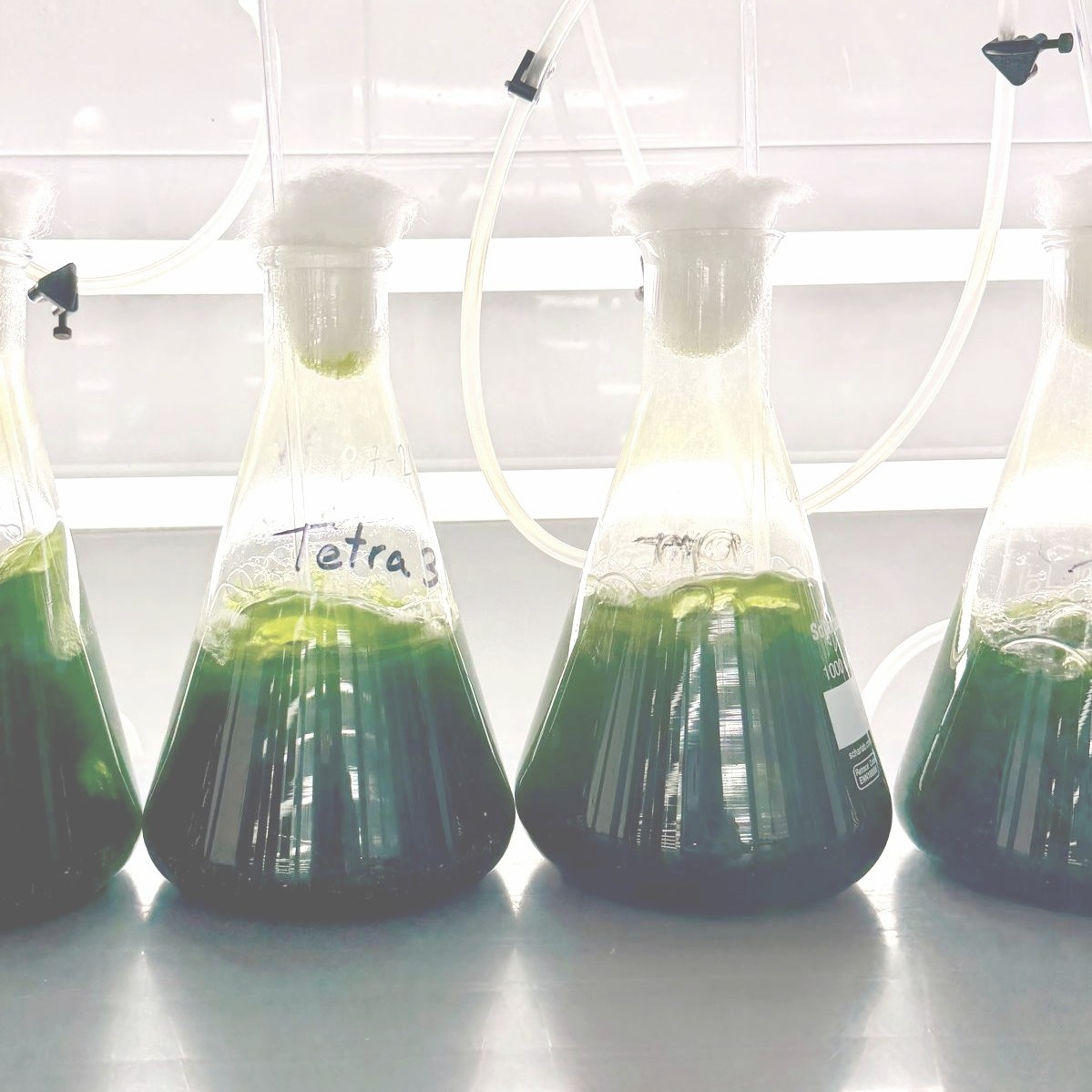
Tetraselmis chuii is the strain we have taken furthest, and it remains our hero. It is one organism in a remarkable field, and our research continues into adjacent organisms and the science of how their compounds are delivered and absorbed.
Tetraselmis chuii
A single-celled marine organism, patent-protected, honed to a single phenotype and DNA-mapped, cultivated in closed-loop clinical-grade systems. Two decades of marine science sit behind it.
What distinguishes it is that it appears to act upstream of your own antioxidant system, raising the expression of NRF2 and SIRT1, the regulators that govern your body's own defense and renewal. That has been measured directly in people.*
It is a rare thing to be able to show that in a human trial, and it is why this strain sits at the centre of everything we make.
Published, peer-reviewed, and human-trialled.
Two decades of published work on this strain, from the laboratory through to a human trial.
Human-trialled
Randomised, double-blind, placebo-controlled
Peer-reviewed
Published in the scientific literature
20+ years
Of research on the strain and its lineage
Randomised, double-blind, placebo-controlled — human
In a human trial, the strain raised NRF2 and SIRT1 expression alongside several of the body's own antioxidant-enzyme genes. The first trial of its kind for this strain.*
Human muscle cells
Raised the activity of the body's own antioxidant enzymes — superoxide dismutase, glutathione peroxidase and catalase — and up-regulated NRF2.
Proteomic analysis
Mapped the strain's proteins and identified the peptides that activate NRF2. Antioxidant capacity rose through digestion.
Preclinical model
Antioxidant and anti-inflammatory activity.
Cellular longevity
Telomere protection under oxidative stress.
Published research
The strain's role in recovery and aerobic capacity.
Our practitioner program holds the full study library: methods, cohorts, endpoints, our candid read on each paper, and the earlier-stage research we keep out of consumer materials.
*Measured in a randomised, double-blind, placebo-controlled human trial (Cocksedge et al., 2025).